How to Choose the Right Slab for Your Project (Complete Guide)
There is something deeply satisfying about working with a real wood slab. No two pieces are identical, every grain pattern tells a different story, and the finished result carries a warmth that manufactured materials simply cannot replicate. But with that beauty comes a learning curve, especially when you are standing in front of a stack of slabs and wondering which one is actually right for what you are building.
Whether you are planning a live edge dining table, a rustic kitchen countertop, a custom desk, or a floating shelf, choosing the wrong slab can cost you time, money, and serious frustration. This guide walks you through every factor that matters so you can shop with confidence and build with purpose.
What Exactly Is a Wood Slab?
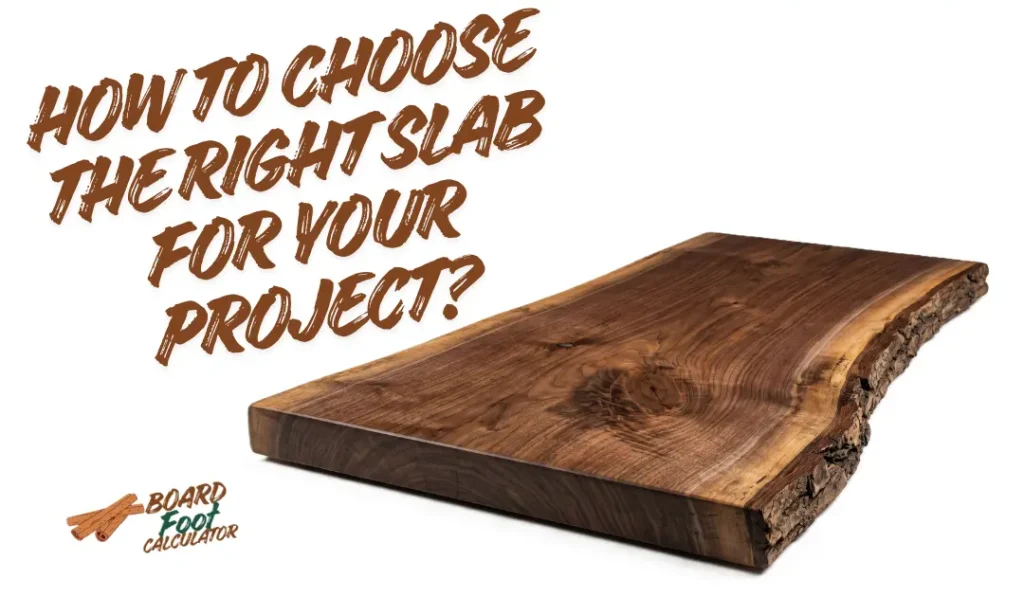
A wood slab is a wide, single board cut lengthwise from the full trunk of a tree. Unlike dimensional lumber, which is milled into uniform strips and often dried quickly for mass production, a slab preserves much of the tree’s original width and, in the case of live edge slabs, its natural irregular edge.
That natural edge (commonly called the live edge) is the boundary between the heartwood and the original bark. It is what gives live edge furniture its organic, one-of-a-kind character. Slabs are used for dining tables, conference tables, kitchen islands, bar tops, countertops, benches, coffee tables, shelves, desks, and decorative wall panels.
Understanding what a slab is at the most basic level helps you ask better questions and evaluate options more critically when you start shopping.
Step 1: Define Your Project Before You Shop
The single most common mistake people make when buying a slab is browsing before they have a clear plan. Slabs are not interchangeable. A piece that is perfect for a coffee table might be completely wrong for a dining surface, and a slab that looks stunning in person might not fit through your front door.
Before you contact a supplier or browse an inventory, answer these questions clearly:
- What are the finished dimensions you need? Always add two to four inches in every direction to account for trimming, flattening, sanding, and any natural defect removal. A slab that measures 84 inches rough may finish to 80 inches, which might be shorter than you need.
- How many people will use the surface? For dining tables, a useful rule of thumb is to allow 24 to 30 inches per person along the sides, and 30 to 36 inches of depth is the standard comfortable range. For a coffee table, 16 to 18 inches in height is typical. For a desk, you need to factor in chair clearance, usually 12 to 18 inches behind the seated user.
- Will this piece live indoors or outdoors? Most live edge slabs are intended for interior use. Outdoor applications require specific wood species that resist moisture and insect damage, as well as specialized finishing products.
- Do you need a single slab or a bookmatched pair? For wide dining tables or large countertops, a bookmatched pair (two slabs cut consecutively from the same log and opened like a book) offers a symmetrical, dramatic look. For smaller pieces, a single slab is often plenty.
- What is your skill level with wood? Some slabs arrive with significant cupping, twist, or surface texture that requires a wide drum sander, a router sled, or a thickness planer to flatten properly. If you are a beginner, look for slabs that are already surfaced and flattened, often labeled S2S (surfaced two sides).
Knowing these answers before you shop prevents the very expensive and very common mistake of buying a slab that does not work for your project.
Step 2: Pick the Right Wood Species
Wood species is one of the most important decisions you will make, and it affects everything from color and grain to hardness, workability, and long-term durability.
Here is a look at the most commonly available slab species and what each brings to a project:
- Walnut is the gold standard of live edge furniture. Its rich chocolate brown heartwood, often streaked with purple and grey tones, makes it one of the most visually stunning choices available. Walnut is moderately hard, works beautifully with hand and power tools, and takes finish exceptionally well. It does carry a premium price, but the results justify the cost for statement pieces like dining tables and desks.
- White Oak has become increasingly popular for good reason. It is harder than walnut, highly stable, and features a distinctive ray fleck pattern in the grain that catches the light beautifully. White oak is also naturally resistant to moisture, which makes it a smart choice for kitchen surfaces and countertops.
- Maple ranges from soft to hard varieties. Hard maple is one of the densest domestic hardwoods available, making it ideal for countertops, kitchen islands, and butcher block style surfaces. Its light, creamy color provides a clean, modern aesthetic that works well in contemporary spaces.
- Cherry starts as a light pinkish-red and deepens to a rich reddish-brown over time when exposed to light. This natural patina is one of the most beloved characteristics in fine furniture. Cherry is smooth-grained, relatively easy to work, and has a timeless elegance.
- Ash is a lighter species with a striking, open grain. It is strong and flexible, historically used in tool handles and sports equipment, and offers an interesting visual alternative for those who want grain character without the darkness of walnut.
- Elm and Sycamore bring unusual and interlocking grain patterns that can be genuinely spectacular in slabs. Both require experienced handling because their grain direction can shift unpredictably, but the results are visually extraordinary.
- Claro Walnut is a West Coast variety prized for its extreme figure and color variation. It tends to be more exotic and expensive than black walnut, often featuring swirling grain, burl inclusions, and dramatic tonal contrast.
When choosing a species, think about the room where the piece will live. Warm-toned woods like walnut and cherry work beautifully in traditional or transitional spaces. Lighter species like maple and ash suit modern and Scandinavian aesthetics. And if you want something truly one of a kind, explore figured or figured varieties within any species, like curly maple, quilted maple, or spalted versions of many common hardwoods.
Step 3: Understand Slab Sizing and How to Measure Correctly
Before you commit to any slab, you need to know exactly how to measure for your project, and you need to understand how wood measurement differs from what you might expect.
Lumber and slabs are traditionally sold using a unit called the board foot. A board foot equals 144 cubic inches of wood, calculated as thickness in inches multiplied by width in inches multiplied by length in feet, divided by 12. This is very different from square footage, and confusing the two is one of the most common errors buyers make when estimating costs.
If you are working with rough slab dimensions and need to calculate how much wood you are buying, a lumber calculator can save you significant time and help you avoid overpaying or underbuying.
For projects where you need to convert between board feet and square feet, for example when comparing a slab price to a per-square-foot estimate for a countertop material, a dedicated board feet to square feet converter makes the math fast and accurate.
Measuring a rough slab yourself requires taking the width at multiple points since most live edge slabs are not uniform in width from end to end. Measure at the narrowest point to get your minimum usable width, then again at the widest point. Also note any natural voids, cracks, or bark inclusions that might reduce the usable surface area.
Step 4: Evaluate Grain, Figure, and Natural Character
This is where slab selection becomes deeply personal. Two slabs of the same species, cut from the same tree, can look dramatically different depending on how the log was oriented during milling.
- Plain sawn slabs are cut with the growth rings running roughly parallel to the face. This produces the characteristic cathedral arch grain patterns most people associate with wood furniture. It is the most common and most affordable cut.
- Quarter sawn slabs are cut at roughly 90 degrees to the growth rings, producing straight, parallel grain lines and, in species like oak, a beautiful ray fleck figure. Quarter sawn lumber is more stable dimensionally, meaning it moves less with changes in humidity and temperature.
- Rift sawn falls between the two and produces very straight, consistent grain with minimal figure. It is prized in modern and contemporary furniture design for its clean, uniform look.
Beyond the cut, look for a figure. Figure refers to unusual patterns in the grain caused by stress, genetics, or growth conditions:
- A curly or tiger figure creates a rippling, three-dimensional shimmer across the surface.
- Burl figure results from abnormal growth on the tree, producing swirling, knotted patterns that are highly prized and priced accordingly.
- Spalting is caused by fungal action in dead or dying wood and creates dramatic black lines (called zone lines) across the surface.
- Properly dried spalted wood is perfectly stable and structurally sound.
Natural voids, knots, cracks, and checks are part of a live edge slab’s personality. Many of these can be filled with epoxy resin to create a stable, level surface while preserving the visual character of the wood. This is a common and well-established technique in live edge furniture building.
When evaluating grain and figure in person, wet the surface of the slab slightly with water or mineral spirits. This simulates what the wood will look like once finished and helps you see the true depth and character of the grain before you commit.
Step 5: Check Moisture Content, Drying Method, and Storage Quality
This is the step that separates experienced buyers from disappointed ones. Moisture is the single greatest enemy of finished wood furniture. A slab that has not been properly dried will warp, cup, twist, crack, and eventually fall apart, regardless of how beautiful it looked when you bought it.
Furniture grade wood needs to be dried down to approximately 8 to 12 percent moisture content for indoor use. The Urban Wood Co. notes that for indoor furniture, the target moisture range is typically 6 to 10 percent, because that range keeps wood movement manageable once the piece is in a heated, conditioned home.
There are two primary drying methods, and understanding the difference matters:
- Air drying involves stacking slabs separated by small sticks (called stickers) to allow airflow between each piece, then storing them in a covered, protected space. A general rule is one year of air drying per inch of thickness. A three inch thick slab needs approximately three years of air drying before it is ready. This slow process allows moisture to leave the wood gradually, which minimizes internal stress and reduces the risk of cracking.
- Kiln drying uses a temperature and humidity controlled chamber to accelerate the drying process. Done correctly, kiln drying can produce stable, furniture-ready wood in a fraction of the time. However, slabs put into a kiln too early (before sufficient air drying) can experience rapid moisture loss that leads to significant cracking and degradation.
The best approach, used by quality suppliers, is a combination of the two: air dry the slabs first to bring moisture content down gradually, then finish in a kiln for final conditioning. When you are buying a slab, ask the seller directly:
- What is the current moisture content of this slab?
- How was it stored during the drying process?
- Was it air dried, kiln dried, or both?
A reputable supplier will have these answers ready. If they cannot tell you the moisture content, consider that a red flag. A moisture meter reading should be available for any slab being sold for furniture use.
Also ask how the slabs are stored at the yard or warehouse. Slabs should be stored flat, stickered to allow airflow, in a covered location protected from rain and direct sun. Slabs stored directly on the ground or leaning against walls will warp and can develop mold, which compromises both appearance and structural integrity.
Step 6: Choose the Right Thickness for Your Application
Slab thickness is directly tied to the structural demands of your project. Too thin and the piece lacks the strength and visual weight that makes live edge furniture so impressive. Too thick and you add unnecessary cost and weight without gaining practical benefit.
Here are general thickness guidelines by application:
- A finished dining or conference table typically looks and performs best at 1.75 to 2.5 inches thick.
- Thicker slabs in the 2 to 3 inch range work especially well for wide pieces where spanning strength is important.
- A finished coffee table or side table can work at 1.5 to 2 inches.
- A floating shelf or wall panel can be thinner, from 1 to 1.5 inches, depending on the span and load.
- Kitchen countertops and bar tops are typically 1.5 to 2 inches finished. Benches benefit from 2 inch or thicker slabs for visual weight and durability.
Keep in mind that rough slab thickness will reduce by 0.25 to 0.5 inches during the flattening and surfacing process. A slab listed as 2.5 inches rough might finish to about 2 inches, which is important to factor in when you are comparing options.
For slabs that are already flattened and surfaced, measure carefully and verify the finished thickness meets your needs before purchasing.
Step 7: Assess the Natural Edge and Bark Condition
The natural edge is the defining visual feature of a live edge slab, and its condition deserves careful evaluation before you buy.
Some slabs come with bark still attached. Bark that is tightly bonded to the wood can sometimes be preserved as a decorative element, though it is prone to separating over time and is generally not recommended for functional surfaces like tabletops. Most live edge furniture makers remove the bark and work with the clean natural edge revealed beneath.
Look for the following when evaluating the edge:
- A clean, intact natural edge with smooth sapwood (the lighter colored wood just inside the bark line) is generally the most desirable.
- Checking (small cracks that radiate from the edge) is common and can often be stabilized with thin cyanoacrylate glue or epoxy.
- Significant delamination between the sapwood and heartwood at the edges can be a structural concern on wide or heavily loaded pieces.
- Unusual curves or undercuts in the natural edge add visual drama and are often considered assets rather than flaws.
The sapwood (lighter colored wood at the edge of a slab) is sometimes seen as a defect by traditional woodworkers, but in live edge design, it is often embraced as part of the visual story. Whether you include or trim the sapwood is entirely a design decision.
Step 8: Match the Slab to Your Skill Level and Shop Setup
Not all slabs are created equal in terms of the work required to bring them to a finished surface. Understanding what you are buying and what you will need to do with it before finishing is critical.
- Rough slabs come directly from the sawmill. They may be uneven in thickness, have saw marks on the surface, and require flattening before they can be finished. Flattening a rough slab requires either a wide belt sander, a drum sander, or a router sled. Without the right equipment, working with rough slabs is very difficult.
- S2S slabs (surfaced two sides) have been run through a planer or drum sander and arrive with both faces flat, parallel, and smooth. These are much easier for intermediate woodworkers to handle and require significantly less preparation before finishing.
- Pre-flattened or shop-ready slabs are the most accessible option for beginners. They arrive ready for final sanding, edge treatment, and finishing with minimal additional processing.
If you are new to working with slabs, starting with a pre-flattened piece in a manageable size is a smart choice. Take on a more challenging rough slab once you have the skills and equipment to handle it properly.
Step 9: Plan for Wood Movement
Wood is a living material in the sense that it continues to expand and contract with changes in ambient humidity even after it is cut and dried. This is called wood movement, and ignoring it is one of the most common causes of cracked or failed furniture joints.
Wood moves significantly across the grain (from side to side as you look at the face of the slab) and almost not at all with the grain (along the length). This means a wide slab will expand and contract seasonally across its width in response to changes in your home’s humidity levels.
This has practical implications for how you attach a slab to a base. Rigid, fixed connections across the width of a wide slab will result in cracking as the wood tries to move and cannot. Instead, use techniques like slotted screw holes, metal tabletop clips, or figure-eight fasteners that allow the slab to move freely while remaining attached to the base.
Species vary in how much they move. Quartersawn slabs move significantly less across their width than plain sawn slabs of the same species. In environments with dramatic seasonal humidity swings, this difference matters.
Step 10: Choose the Right Finish for Your Application
The finish you apply to a slab is not just an aesthetic choice. It determines how the wood interacts with its environment, how easy it is to maintain, and how the grain looks once the piece is in its final location.
- Oil finishes (such as hardwax oil, Danish oil, or tung oil) penetrate into the wood rather than forming a film on top. They enhance the natural grain beautifully, give the wood a warm, organic feel, and are easy to repair since you simply reapply oil to scratched or worn areas. The tradeoff is that oil finishes offer less protection against spills and require periodic reapplication, typically once or twice a year depending on use.
- Film finishes (such as polyurethane, conversion varnish, or lacquer) sit on top of the wood and form a protective layer. They offer superior protection against moisture, spills, and everyday wear. The tradeoff is that they can look slightly plastic if applied thickly, and repairs require sanding back the entire finish before reapplication.
- Epoxy topcoats have become popular for tabletops that need maximum protection. A properly applied epoxy coat creates an extremely hard, water and heat resistant surface. However, epoxy can yellow over time when exposed to UV light, so it is often paired with a UV-resistant topcoat.
- Raw or natural edges are sometimes left unsealed intentionally for a truly organic look. However, any surface that will see regular contact with food, drink, or everyday use should be sealed to prevent moisture absorption and staining.
Match your finish choice to how the piece will actually be used. A dining table that will see daily use, children, and spills benefits from a durable film finish. A decorative shelf or display piece can be beautifully finished with oil.
Evaluating Slab Quality: A Quick Checklist
When you are standing in front of a slab and trying to evaluate its quality, run through these points mentally:
- Is the moisture content confirmed and appropriate for your climate and end use?
- Has the slab been properly stored (flat, stickered, covered, and off the ground)?
- Are checks, cracks, or voids stable, or are they actively moving and worsening?
- Does the slab lie flat, or is there significant cup, bow, or twist?
- Is the natural edge clean and intact, or showing significant delamination?
- Is the grain pattern and figure what you want for your design intent?
- Are the dimensions (length, width at multiple points, and thickness) sufficient for your finished project after material removal?
Working through this checklist before you buy prevents most of the regrets that come from impulse purchases.
Budgeting for a Slab Project
Live edge slabs are a genuine investment, and understanding the total cost of a project before you start prevents unpleasant surprises. The slab itself is just the beginning.
Slab prices vary enormously depending on species, size, figure, and source. Common domestic slabs like ash or elm might cost a few dollars per board foot. Figured walnut or claro walnut can run significantly higher. Exotic or highly figured pieces can reach into the thousands for a single slab.
Beyond the slab, factor in the cost of finishing products, any hardware for attachment to a base, the base itself if you are buying rather than building it, and any professional services like flattening, sanding, or finishing if you are not doing those yourself.
If you are working from detailed dimensions and need to calculate how much material you need in board feet, use a board footage calculator to get accurate numbers before you shop. Having precise figures makes it much easier to compare slabs and avoid buying more than you need or running short.
Final Thoughts
Choosing the right slab for your project is equal parts practical planning and personal instinct. The practical side is measurable: dimensions, species, moisture content, thickness, and grain orientation all have real, objective implications for how your finished piece will perform. The personal side is about finding a piece of wood that moves you, that has the grain, figure, and natural character you want to live with for years or decades.
Take the time to define your project clearly before you shop. Learn the questions worth asking suppliers. Understand what proper drying and storage look like. Know your own skill level and shop setup honestly. And when you find a slab that meets all the practical criteria and still takes your breath away when you wet the surface and see the grain come alive, that is the one to buy.
Good wood is worth the patience it takes to choose well.